
Prostadine Review: Better Formulated Than Its Competitor, and We Do Not Link To It
Prostadine contains saw palmetto, the most studied prostate botanical. That puts its formulation ahead of the alternative we can link to, which is an awkward thing for a commission-funded site to report.
The verdict
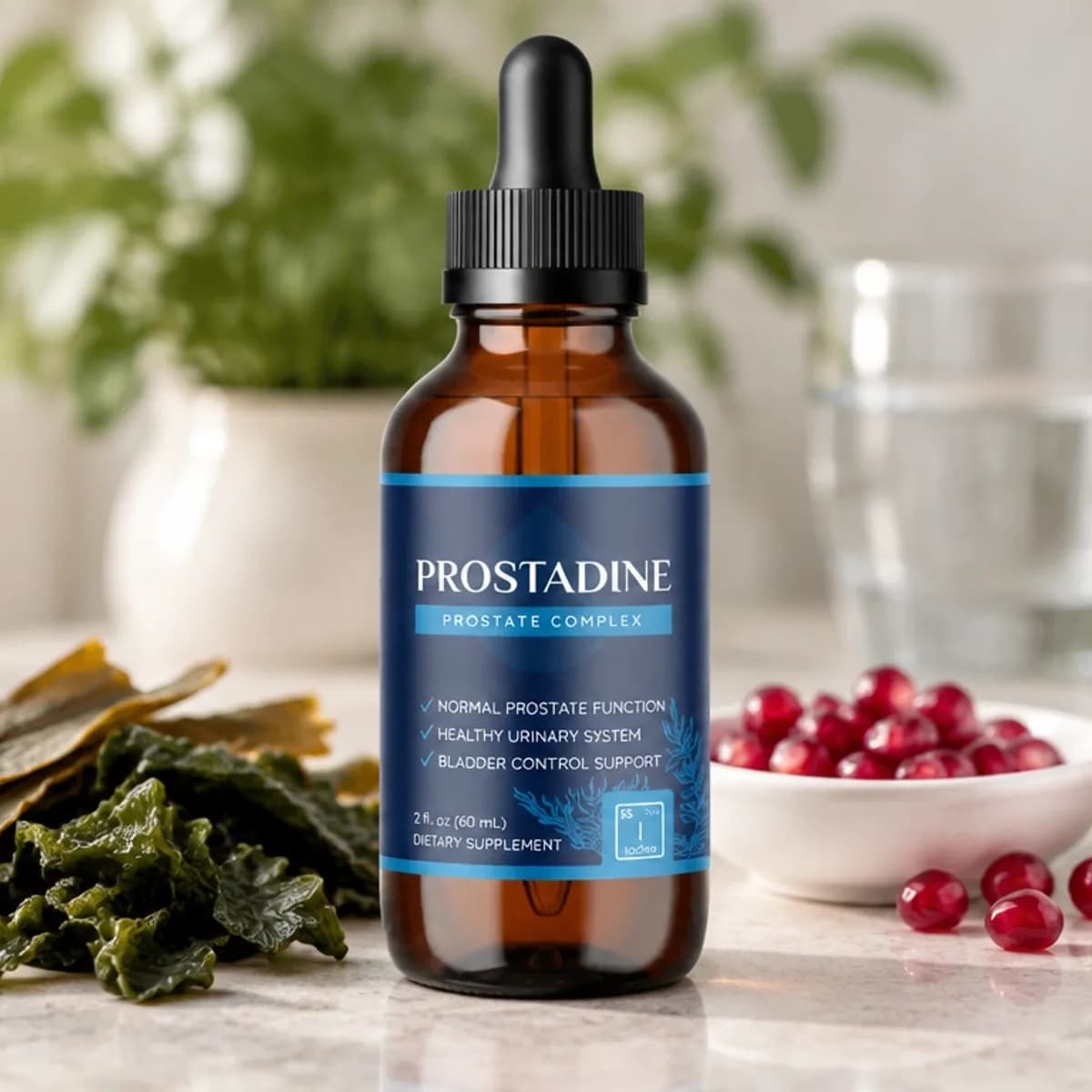
Prostadine
On formulation this is the better of the two prostate products in our registry: it contains saw palmetto and it is built for urinary symptoms rather than libido. We are not linking to it, because its landing copy is what triggered a Microsoft Ads policy strike on this domain, and that is a decision about the advertiser rather than about the formula.
- Best for:
- Nobody through us, currently. Included because the comparison is the useful part
- From:
- Not published on the page we can see; the prices load in the browser rather than in the page
- Evidence quality
- 3.0
- Formulation
- 3.0
- Value
- 2.5
- Transparency
- 2.5
We are not currently linking to this product.
What we liked
- Contains saw palmetto, the reference botanical for benign prostatic hyperplasia
- Iodine-rich sea vegetables are an unusual but defensible inclusion
- Liquid dropper format avoids the capsule volume problem that limits doses elsewhere
- Formulated for the prostate rather than for libido, unlike its main competitor
What gave us pause
- No per-ingredient doses
- Saw palmetto's own evidence is mixed, with the best trials the least positive
- No beta-sitosterol, which has better trial results and is cheaper
- The advertiser's marketing is what earned this publisher an ad-policy strike
A note before anything else, because it affects how you should read this: we earn commission on links, and we are not linking to this product. That makes this the one review on the site with no commercial upside, and it is also the one where the better-formulated of the two is the one we do not link to.
Both of those facts seemed worth stating plainly.
What is in it
Kelp powder, wakame extract, bladderwrack, saw palmetto, pomegranate extract, iodine, shilajit, neem and nori.
That is a prostate formula. Not a testosterone formula with prostate marketing, which is what most of this category actually is.
Saw palmetto, which is the point
Saw palmetto is the most studied botanical in this category by a wide margin, and the honest summary is more complicated than either side admits.
Early trials were positive. The larger, better-controlled ones that followed, including the CAMUS and STEP trials, found no significant benefit over placebo for urinary symptom scores. The Cochrane review reflects that.
So its presence is not proof of efficacy. What it is, is evidence that whoever formulated this was aiming at benign prostatic hyperplasia rather than at what sells. That is a meaningful difference from a formula built on Tongkat Ali and maca.
The sea vegetables are the unusual part: kelp, wakame, bladderwrack and nori are all iodine sources. Iodine has no direct BPH evidence. There is thyroid literature, and thyroid function affects a great deal.
Shilajit has small trials on testosterone and fatigue. Neem and pomegranate are antioxidants with laboratory prostate work and little human data.
What is missing
Beta-sitosterol. It has better trial results than saw palmetto for urinary flow and symptom scores, it is inexpensive, and almost nobody in this category includes it because almost nobody has heard of it.
That is the same gap as in ProstaVive, and it is the most useful thing to know when shopping this category at all.
Why we do not link to it
The advertiser’s landing page is what produced a Microsoft Ads policy strike on this domain. The citation named phrases including “Revolutionary Prostate Supplement That Restores Prostate Health”, “proven to deliver exceptional results” and “Limited Time Special Pricing - Act Now”.
That is a judgement about the advertiser’s marketing, not about what is in the bottle. We have separated the two here rather than quietly dropping the product, because the formulation comparison is genuinely useful.
The alternative we can link to
What to do instead
See a doctor before either. Urinary symptoms in men over fifty have several causes, and benign prostatic hyperplasia is only one of them. Prostate cancer presents similarly in its early stages.
If it is confirmed BPH and you want to try a supplement, beta-sitosterol at a disclosed dose is the better-evidenced and cheaper starting point than anything on this page.
The verdict
2.8 out of 5 on the formula. The same score as the alternative we earn on, and on the better-studied ingredient, which is the finding that made this review worth publishing.
What we could not verify
We have not tested this product. We do not test any product on this site. Checked against the official page on 3 October 2026.
Verified: the 60-day money-back guarantee.
Not verifiable: the prices, which load in the browser rather than in the page. An earlier version of this review quoted $69 a bottle; we cannot source it and it has been removed. Prostadine publishes no supplement facts panel anywhere we can find, no certificate of analysis, no named manufacturer and no trial on the finished formula.
The reason there is no buy button on this page is separate from all of that: the offer is paused because its landing copy triggered a Microsoft Ads policy warning against this domain. That is a decision about advertising risk, not a verdict on the powder.
Every published figure here also appears in the dose gap, with its source and the date we read it. How these scores are arrived at is set out in how we review, and the evidence hierarchy is on research standards.
References
- 1.Tacklind J, et al. Serenoa repens for benign prostatic hyperplasia. Cochrane Database of Systematic Reviews.
- 2.Barry MJ, et al. Effect of increasing doses of saw palmetto extract on lower urinary tract symptoms (CAMUS randomized trial). JAMA, 2011.
- 3.Bent S, et al. Saw palmetto for benign prostatic hyperplasia. New England Journal of Medicine, 2006.
- 4.Wilt T, et al. Beta-sitosterols for benign prostatic hyperplasia. Cochrane Database of Systematic Reviews.
- 5.Leung AM, Braverman LE. Consequences of excess iodine. Nature Reviews Endocrinology, 2014.